
Dynamics of Elementary Particles
Background
Elementary particles are everywhere around us. Apart from the standard matter particles proton, neutron and electron, hundreds of other particles have been found, produced in cosmic ray interactions in the atmosphere or by accelerators. Hundreds of charged particles traverse our bodies per second. Some will damage our DNA, which is one of the reasons for the existence of a sophisticated DNA repair mechanism in the cell.
The data for this experiment is in the form of a bubble chamber photograph which shows bubble tracks made by elementary particles as they traverse liquid hydrogen. In the experiment under study, a beam of low-energy negative pions (\(\pi^-\) beam) hits a hydrogen (\( p \) for proton) target inside the bubble chamber.
The bubble chamber is essentially a container with liquid hydrogen normally kept just below its boiling point (\(T=20\) K). As the pions enter the detector a piston slightly decompresses the liquid so it becomes ``super-critical'' and starts boiling, and bubbles form, first at the ionization trails left by the charged particles traversing the liquid. 2. 3.
Reactions
The reaction shown in Figure 1 shows the production of a pair of neutral particles (that do not leave an ionized trail in their wake), which after a short while decay into pairs of charged particles: $$ \pi^- + p \rightarrow \Lambda ^0 + K^0 $$
where the neutrals decay as follows: $$ \Lambda^0 \rightarrow p + \pi^- $$ $$ K^0 \rightarrow \pi^+ + \pi^- $$
In this experiment, we assume the masses of the proton (mp = 938.3 MeV/c2) and the pions \(m_{\pi^+} \) and \(m_{\pi^-} \) (mp + = mp- = 139.4 MeV/c2) to be known precisely, and we shall determine the masses of the \(\Lambda ^0 \) and the \( K^0 \), also in these mass energy units.
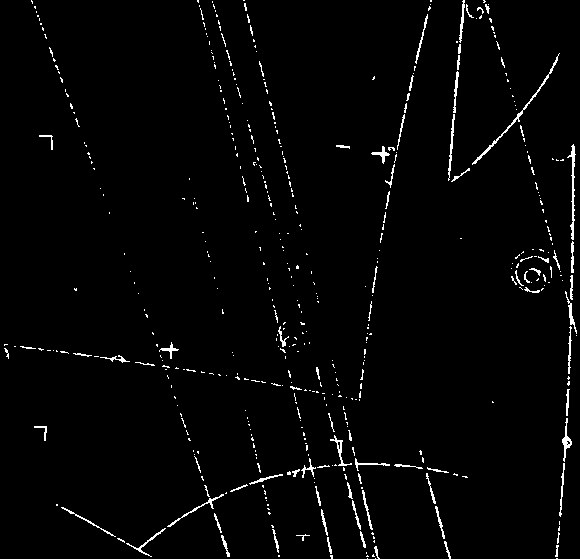
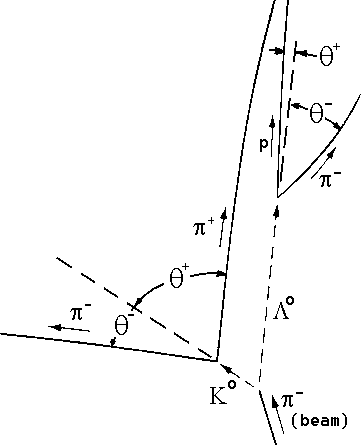
Figure 1, on the left, is the bubble chamber image you will analyze. Figure 2, on the right, is a "cleaned" representation of the image.
Momentum Measurement
In order to "reconstruct'' the interaction completely, one uses the conservation laws of (relativistic) momentum and energy, plus the knowledge of the initial pion beam parameters (mass and momentum). In order to measure momenta of the produced charged particles, the bubble chamber is located inside a magnet that bends the charged particles in helical paths. The 1.5 \(T\) magnetic field is directed up out of the photograph. The momentum p of each particle is directly proportional to the radius of curvature r, which in turn can be calculated from a measurement of the "chord length" \( l\) and "sagitta" \( s \) as: $$ r = [l^2/(8s] + [s/2] $$
Note, that the above is strictly true only if all momenta are perfectly in the plane of the photograph; in actual experiments stereo photographs of the interaction are taken to be able to reconstruct the interaction in all three dimensions. The interaction in this photograph was specially selected for its planarity.
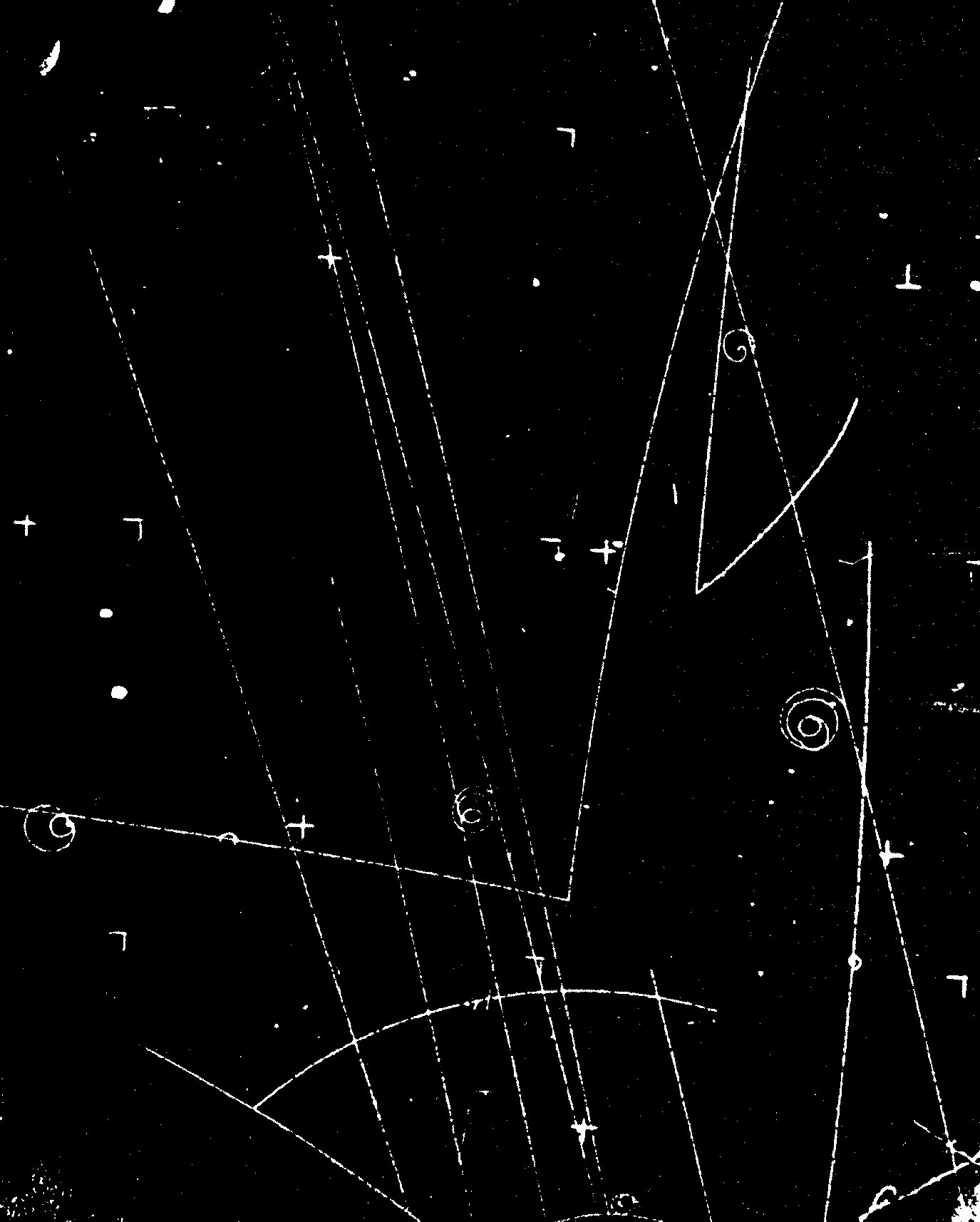
In the reproduced photograph the actual radius of curvature R of the track in the bubble chamber is multiplied by the magnification factor \( m \) where \( r = mR \). For the reproduction in Figure 3, \( m \) = height of photograph (in mm) divided by 173 mm.
The momentum \( p \) of the particles is proportional to their radius of curvature \( R \) in the chamber. To derive this relationship for relativistic particles we begin with Newton's law in the form (Lorentz Force): $$ F = dp/dt = ev \times B $$
Here the momentum \( p \) is the relativistic momentum \( mv\gamma \), where the relativistic \( \gamma \)factor is defined in the usual way \( \gamma = [\sqrt(1-(v^2/c^2))]^{-1} \)
Thus, because the speed \(v\) is constant: $$ F = dp/dt = d(mv\gamma)/dt = m\gamma dv/dt = m\gamma(v^2/R)\hat{r} = evB \hat{r} $$ where \( \hat{r} \) is the unit vector in the radial direction.
Division by \( v \) on both sides of the last equality finally yields: $$ m\gamma R = p/R = eB $$ identical to the non-relativistic result!
In atomic units we find that \( pc\) (in eV) \( =cRB\), thus $$ p ( MeV/c) = (2.998\times 10^8) (R)(B \times 10^{-6}) = 300 R ( meters)B( Tesla) $$
Measurement of angles
Draw straight lines from the point of primary interaction to the points where the \(\Lambda ^0 \) and the \( K^0 \) decay. Extend the lines beyond the decay vertices. Draw tangents to the four decay product tracks at the two vertices. (Take care drawing these tangents, as doing it carelessly is a source of large errors.) Use a protractor to measure the angles of the decay product tracks relative to the parent directions (use Fig. 3 for measurements and Fig. 2 for definitions).
The laws of relativistic kinematics relevant to this calculation are written below. We use the subscripts zero, plus, and minus to refer to the charges of the decaying particles and the decay products. $$ p_+ \sin{\Theta_+} = p_- \sin{\Theta_-} $$ $$ p_0 = p_+ \cos{\Theta_+} + p_- \cos{\Theta_-} $$ $$ E_0 = E_+ + E_- $$ where \( E_+ = \sqrt(p_+^2 c^2 + m_+^2 c^4) \), \( E_- = \sqrt(p_-^2 c^2 + m_-^2 c^4) \), and \(m_0 c^2 = \sqrt(E_0 ^2 - p_0 ^2 c^2) \).
Note that there is a redundancy here. That is, if \( p_+ \), \( p_- \), \( \Theta_+ \) and \( \Theta_- \) are all known, equation (9) is not needed to find \( m_0 \). In our two-dimensional case we have two equations (9 and 10), and only one unknown quantity m0, and the system is over-determined. This is fortunate, because sometimes (as here) one of the four measured quantities will have a large experimental error. When this is the case, it is usually advantageous to use only three of the variables and to use equation (9) to calculate the fourth. Alternatively, one may use the over-determination to "fit'' the \( m_0 \), and to determine it more precisely.K0 decay.
- Measure three of the quantities \( r_+ \), \(r_- \), \( \Theta_+ \), and \(\Theta_-\). Omit the one which you believe would introduce the largest experimental error if used to determine \(m_K \)
- Use the magnification factor m to calculate the actual radii R and equation (8) to calculate the momenta (in MeV/c) of one or both pions.
- Use the equations above to determine the rest mass (in MeV/c2) of the K0.
- Carefully estimate the error in your result from the errors in the measured quantities.
- The proton track is too straight to be well measured in curvature. Also, \( \Theta_+ \) is small, and the value of \( m_\Lambda \) is quite sensitive to this measurement. Assume that \( \Theta_+ \) = 0.32±0.05 ° (check this with a protractor). Measure \( r_- \) and \( \Theta_- \)
- Calculate \( m_\Lambda \) and its error the same way as for the \(K^0\).
- Finally, compare your values with the accepted mass values (the world average), and discuss.
- Calculate the momenta for both neutral particles, and hence find their lifetimes, both in the laboratory, and in their own rest-frames. Compare the latter with the accepted values [3].
These references were cited by the original authors of this lab manual, Dr. Rijssenbeek of Stony Brook and Dr. Wahl of Florida State University. Many thanks to them for developing this experiment.
- [1] G.D. Coughlan and J.E. Dodd: “The ideas of particle
physics”,
Cambridge Univ. Press, Cambridge 1991 - [2] “The Particle Adventure”, http:// pdg.lbl.gov/cpep/adventure.html
- [3] Review of Particle Physics, by the Particle Data Group,
European
Physical Journal C3 (1998) 1 - 794
(previous edition: Physical Review D54 (1996) 1 - 720) (available on WWW: http://pdg.lbl.gov) - [4] Kenneth Krane: Modern Physics, 2nd ed. ; John Wiley & Sons, New York 1996
Hovering over these bubbles will make a footnote pop up. Gray footnotes are citations and links to outside references.
Blue footnotes are discussions of general physics material that would break up the flow of explanation to include directly. These can be important subtleties, advanced material, historical asides, hints for questions, etc.
Yellow footnotes are details about experimental procedure or analysis. These can be reminders about how to use equipment, explanations of how to get good results, troubleshooting tips, or clarifications on details of frequent confusion.
This method avoids the complicated problem of determining the exact dimensions of the cavity, which is a difficult E&M problem with complex boundary conditions.
The platform is often called a "goniometer", which means "angle measuring device".
Chapter references are for "Modern Physics for Scientists and Engineers, 4th Edition" by Stephen Thornton and Andrew Rex, Cengage Publishing. Waves and Particles, Chapter 1, Section 3.
Thornton and Rex. X-ray Scattering, Chapter 5, Section 1.
Thornton and Rex. Stucture of DNA, Figure 5.6
Thornton and Rex. X-ray Scattering, 5.1 and Solids, Section 10.3
https://www.nobelprize.org/prizes/physics/1960/summary/